The Science behind Stress: Understanding Stress at BIFU
Is there an upcoming test? Did I review for the quiz next week? Oh, wait, did I forget to do the homework due today?
Stress is extremely common, especially in schools with a rigorous curriculum, like BIF. This article will dive into why individuals feel pressured, and how students can cope.
According to the OECD (Organisation for Economic Co-operation and Development) around 55 out of 100 students feel very anxious about school testing, even when they are well prepared. As many as 37% of students report feeling very tense when studying, and girls consistently report greater anxiety surrounding schoolwork as compared to boys.
Stress is the natural reaction your body has when changes or challenges occur. It can result in many different physical, emotional, and behavioral responses. Everyone experiences stress from time to time; it is often unavoidable.
Stress responses help your body adjust to new situations, along with keeping you alert, motivated, and ready to avoid danger. For example, during high stakes situations, such as an important test, a stress response might help the human body work harder and stay awake longer. However, stress becomes a problem when stressors continue without relief or periods of relaxation.
There are three main kinds of stress: acute, episodic acute, and chronic.
Acute stress is short-term stress that comes and goes quickly. It’s the feeling that comes with riding a rollercoaster or having a fight with a friend. Everyone experiences acute stress from time to time. Episodic acute stress is when someone experiences acute stress regularly. With this kind of stress, individuals don’t ever get the time they need to return to a calm, relaxed state. Chronic stress is long-term stress that goes on for weeks or months. People may experience chronic stress due to issues at school, family problems, or their relationship with a significant other. It’s important to find ways to manage stress, because it can lead to health issues if untreated for a long period of time.
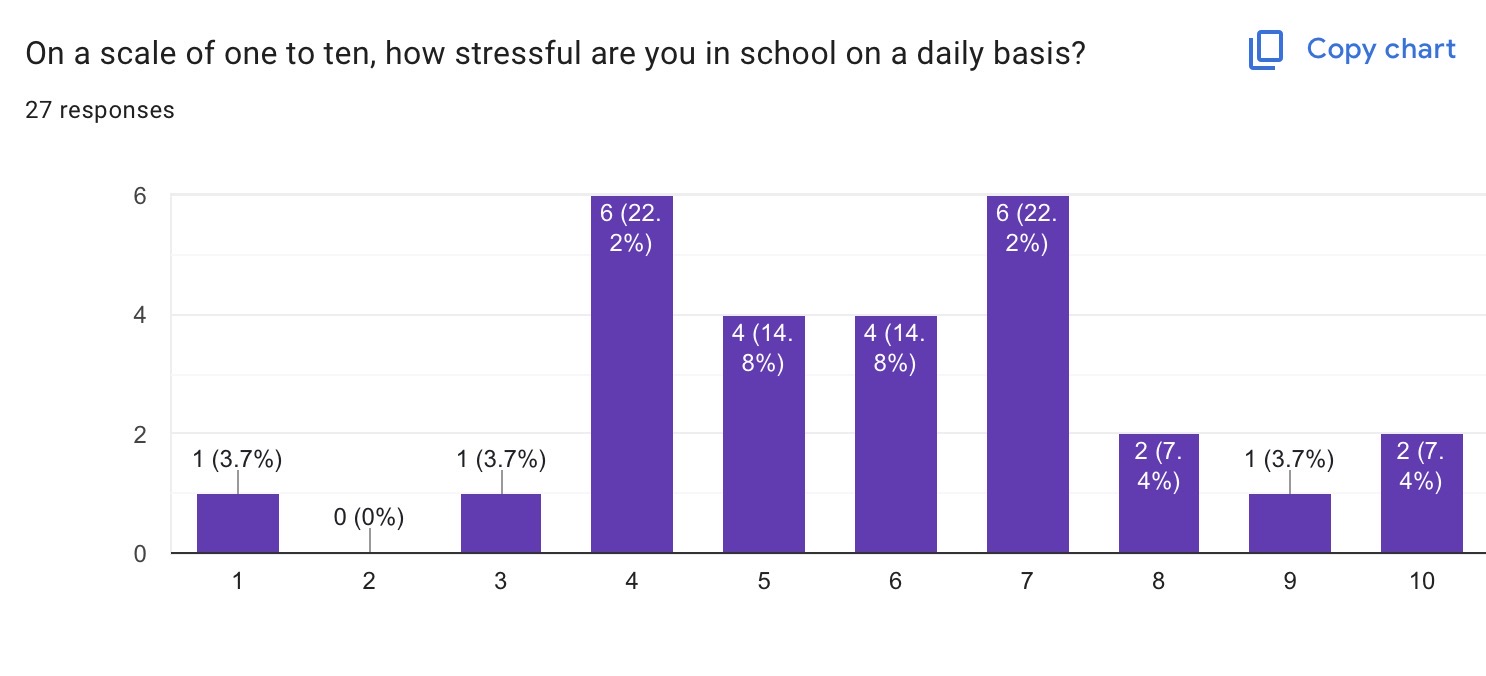
In a survey of 27 students in grades six through nine, the average reported stress level was 7 out of 10. Most respondents said that homework and tests caused much of their anxiety, and some said that certain subjects were stressful because of the amount of homework.
Stated by Mithra Ariasp (9): “There is so much schoolwork…I spend my lunches and class periods grinding work nonstop. Not to mention more than three tests, projects, or long assignments per week! Even during break!”
In these ways, students have felt extremely overwhelmed by everyday classes and exams almost twice a week. Test results and grade reports are also reasons why many students stay up late and do not get enough sleep regularly.
Stated by an anonymous peer in 7th grade, “I try to start sleeping at 10:00 pm - 10:30 pm, but I fall asleep a lot later, like one or two am. Aside from sometimes being tired, it doesn’t affect my studies or behavior.”
However, not all students felt this way, with some students reporting low levels of stress. Abhigya Pandey (7) stated that her level of stress was one, as well as two other students.
Peer pressure and sometimes parental pressures have also greatly influenced the stress level of individuals.
Zehra Araci (7) says she has a stress level of nine and remarks, “There’s a lot of peer pressure from other students doing better, and of course parents also pressure you to be perfect all the time, anxiety is a big factor in stress with the loads of homework we get, late nights are getting really late!”
Peer pressure is a social force that influences individuals to conform to the attitudes, behaviors, and actions of their peers.
Isabelle Shi (6) states, “I have pressure on tests, since many parents have high standards to get A’s.”
Middle school friendships can feel intense because everyone is figuring out who they are and where they fit in. There’s often pressure to belong, which can make people change how they act or choose friends based on popularity instead of trust. Misunderstandings and conflict can happen easily, and it may feel like small problems are a big deal. Learning to balance fitting in with staying true to yourself is one of the biggest challenges during this time.
One seventh grader said, “The teachers give us some stress, including homework, tests, etc. Also, arguments with classmates make things a lot more sad and stressful.”
For sixth graders starting middle school, it can be quite challenging to cope with the new curriculum and the pressure of the environment.
A 6th grader stated, “It’s because school is starting to be harder in middle school, and I need to catch up.. I have lots of tests and homework…I really need to manage my time well along with my extracurriculars.”
In the end, peer pressure and stress are a normal part of middle school, but they don’t have to control your choices or your well-being. Learning to set boundaries, choose supportive friends, and stay true to your values can make a big difference. Even though it may feel overwhelming at times, these challenges help build confidence and resilience, shaping stronger and more independent individuals over time.