Capstones and Cut Time: Senior Year’s Unique Structure
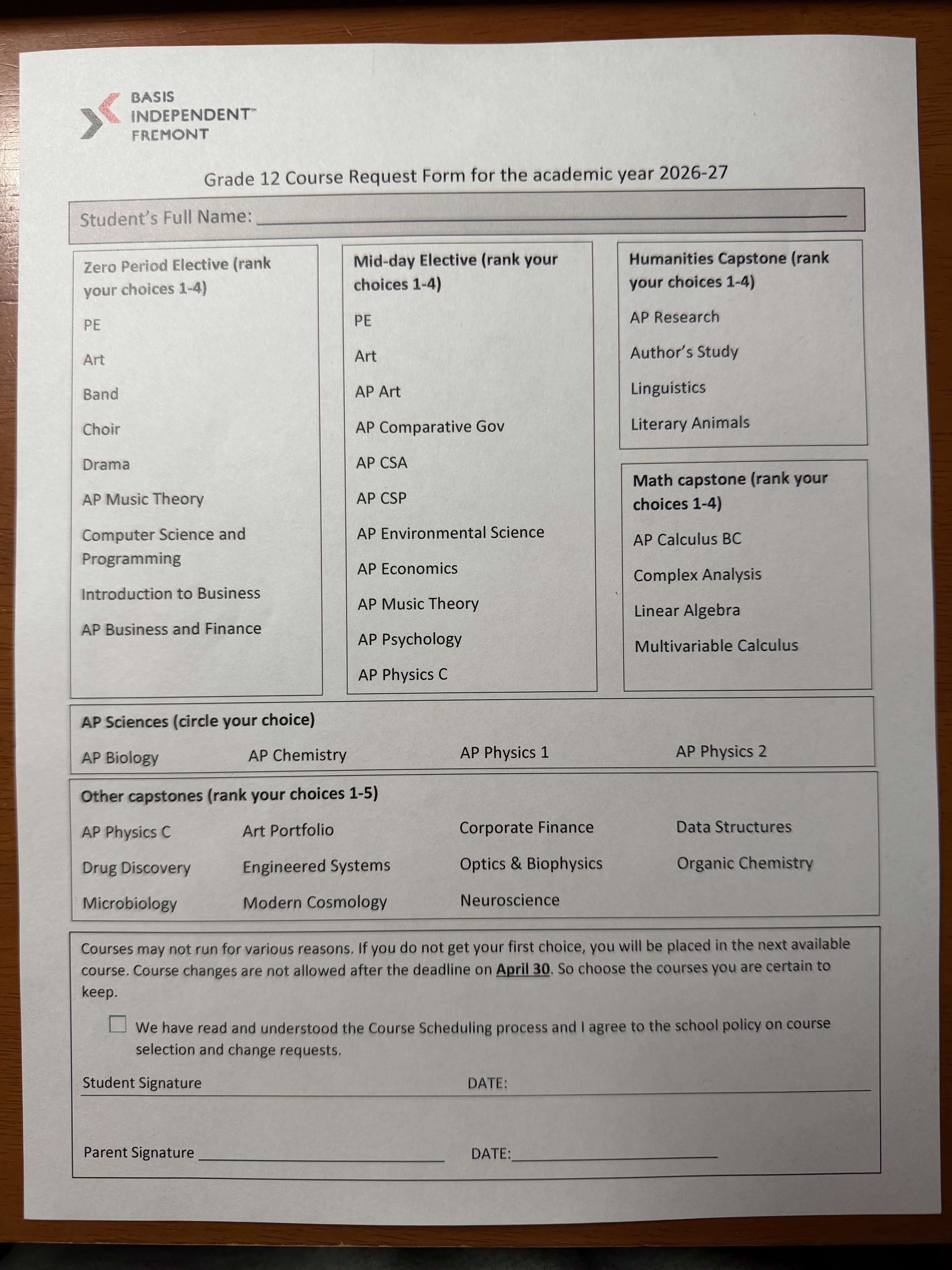
As the rising seniors fill out their course selection forms this year, they may be filled with anxiety, from fear of not getting their first-choice classes, or maybe even annoyance due to not meeting the prerequisite for a certain Capstone. Senior year is arguably the most unique experience BIFU has to offer. With extremely specific courses and only having students on campus for two trimesters, BIFU’s schedule has the rising seniors bracing themselves for an exciting yet bittersweet end to their high school career, starting with course selection.
When students undertake the daunting task of choosing classes, a common first step is to gather feedback from students who have already taken the classes. However, at BIFU, this is a bit of a challenge due to small class sizes. Some Capstones only enroll a handful of students, who all chose the class because they have a large interest in the course material. A lot of the Capstones that show up on the course selection also aren’t guaranteed to run the next year and depend on student interest and scheduling conflicts.
“The struggle always is to kind of make everyone happy. Teachers [and students] will have certain requirements…Those are all challenges, and even though we tell everyone that this is how it's going to be, you know things change in the end,” said Ms. Suguna, who is in charge of course scheduling for all BIFU students.
The best way students should approach senior year course selection is by picking the classes that interest them the most since students have limited control over which classes make it to the schedule. A lot of the Capstone courses tend to be STEM-related, as this year’s seniors had the option to choose between Microbiology, Cosmology, and even Anatomy and Physiology. On the contrary, there was only one distinct art Capstone, Art Portfolio, which had an AP 2D Art prerequisite. This is just an example of the imbalance of variety in Capstones. For students interested in biology and physics, there were many options, but for many, choosing second, third, and fourth alternatives proved difficult due to the limited options.
“When I was in junior year, we gave a ranking for each course requirement, and then what ended up happening was none of my elective choices worked out, so I ended up going with classes that I wasn’t even interested in,” said Ailsa Wu (12).
In the end, these Capstones only last two trimesters and are intended to mimic the more student-reliant style of undergraduate study, as many of the classes involve a conclusive research-based Capstone project. It’s up to the student how much they want to gain from the Capstone, which applies to all high school classes in general.
Besides course selection, another major aspect of senior year is the two-trimester system, which has both losses and gains.
“I feel like the workload was super mismanaged between trimesters. T1 was so easy, and T2 was some of the most stressful weeks we’ve ever had,” said Shreyas Jay (12). “I wish there was a better balance; I love being off early though.”
As Jay described, while time off from T3 for students to travel, work a real job, or just relax is undeniably appreciated, the workload between the first two trimesters could be distributed better. T1 is when seniors write most of their college applications, so teachers are most likely trying to be accommodating of their students’ workload during that period. However, this decision ends up pushing a lot of the major assignments from all the Capstones into a very hectic T2 with Capstone projects, the Senior Symposium, and other final exams.
At BIFU, the senior year schedule allows students to go off on their own to research their specific interests through Capstone courses. Still, students face difficulties with getting the courses they want and organizing their time in T2, all in their short but sweet last year of high school.