3I/ATLAS Approaches Earth
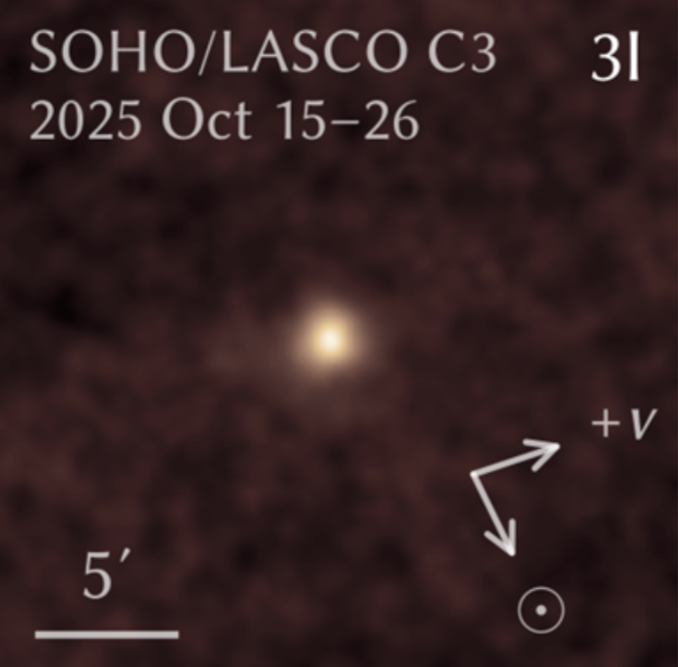
When using a small telescope to look into the night sky on December 19, red and green lights can be seen. However, these are not Christmas lights, but rather are the colors of 3I/ATLAS.
3I/ATLAS, also known as C/2025 N1 (ATLAS), is an interstellar comet that is being studied by NASA and other space agencies. It was first discovered on July 1st, 2025. Expectations are that 3I/ATLAS will be closest to Earth on December 19, a day many are excitedly waiting to use their telescopes to get a glimpse of this comet. This is due to the unique features making this interstellar comet well-known.
One unique detail about this comet is its interstellar origin.
“Scientists are very intrigued by this object, because we have very, very strong evidence to tell us that it's not part of our solar system,” said physics teacher Dr. Dixit.
Its high velocity is another feature that has captured the interest of scientists. Its velocity has been reported to have increased to 153,000 miles per hour as it reaches closer to the Sun.
“It's going very, very, very fast, and we're lucky that it's not going to collide with us,” said student Helena Huang (10), “But this could tell us that there is stuff out there that goes this fast, and we could try and create more preparations to avoid stuff like this.”
The very high velocity of 3I/ATLAS has caused some to wonder whether this would be a danger to Earth. However, despite its speed, it will remain far from Earth, rejecting any concerns of a collision.
Compared to other comets, 3I/ATLAS happens to also have a very unique chemical composition that helps determine its age.
“Its chemical composition is pretty unique, and the fact that it has so much nickel as a primary element, points to the fact that a lot of the chemical map of our universe probably has its origins way back in time,” continued Dr. Dixit.
The high contents of nickel in 3I/ATLAS help indicate its age to be over 7 billion years old. This is even older than Earth itself.
With such an interesting discovery, many opportunities may potentially arise, including new discoveries.
“Equipment is getting better and data processing is getting a lot better. There's a lot more opportunities for observation of it as it travels interstellarly,” said physics teacher Mr. Vidal, “That would open up new avenues of discovery in terms of what is observed and what is done with data that comes from that.”
Despite all this data, there have been many theories surrounding 3I/ATLAS and its potential to be an alien spacecraft rather than a comet. Since then, the scientific community has rejected these theories, and there are many that believe it’s just an entity made of rock and ice. On the other hand, there are few who agree with it being just a comet, but do not fully reject the possibilities of aliens.
“I don't think you can entirely exclude the possibility,” continued Mr. Vidal, “But again, based on the scientific processes we're saying the evidence is another comet, rather than something unique, but you can never rule it out.”
Overall, 3I/ATLAS, with its uniqueness, has captured the hearts and minds of many interested in science and space as it continues to approach Earth.
“It's mind boggling that an interstellar traveler can even present itself the way it does to us humans on Earth,” said Dr. Dixit, “I get tickled by the idea that the vastness of space has still allowed something from outside our solar system to make such a grand entry in our night sky.”